
Old Toronto: the most competitive search market in Canada
Walk south of Bloor Street, east of High Park, west of the Don River, and north of Lake Ontario and you're standing in the original City of Toronto — the dense, walkable, heritage core that existed before amalgamation in 1998. Old Toronto packs roughly 800,000 residents into just 97 square kilometres — a population density rivaling Manhattan's outer boroughs — alongside the country's largest concentration of corporate headquarters, the entire Financial District, and tens of thousands of small independent businesses competing fang-and-claw for every commercial-intent search.
Here's the paradox: every digital agency in the GTA sells "Toronto SEO" — and almost all of them assume that means downtown. Which makes downtown the single most saturated, competitive, and unforgiving local search market in the country. A King West design studio is competing not against neighbourhood rivals but against the entire global category. A Queen West retailer is competing against marketplace listings, national chains, and DTC brands. A Distillery District restaurant is competing for share-of-mouth with TripAdvisor, OpenTable, and every food blogger in the GTA.
This guide is the playbook we use with our own Old Toronto clients — exactly how to think about local search in the most competitive zip codes in Canada, what the competitive dynamics actually look like, and the specific levers that move rankings, calls, and revenue when easy wins don't exist. If you'd rather skip the reading and have us audit your site directly, request a free Old Toronto SEO audit and we'll send a written analysis within three business days.
Old Toronto at a glance
Before you can build an SEO strategy, you need to understand the market you're ranking in. "Old Toronto" is the formal name for the pre-1998 City of Toronto — the original, dense, walkable core that was amalgamated with North York, Scarborough, Etobicoke, East York, and York into the modern City of Toronto. It contains the Financial District, the Entertainment District, Queen West, King West, the Distillery, the Annex, Yorkville, Cabbagetown, Leslieville, Riverdale, Roncesvalles, Parkdale, and several dozen other distinct neighbourhoods packed into a tiny footprint.
Sources: City of Toronto Open Data, Statistics Canada, Think with Google.
What this means in practical terms: a single business chasing "Old Toronto" with one page is leaving most of the available search demand on the table. The winners segment by neighbourhood, by intent, and by service — and they build dedicated content for each combination that actually matters to their business. We'll cover exactly how that's done in section five.
Why Old Toronto SEO is different from generic Toronto SEO
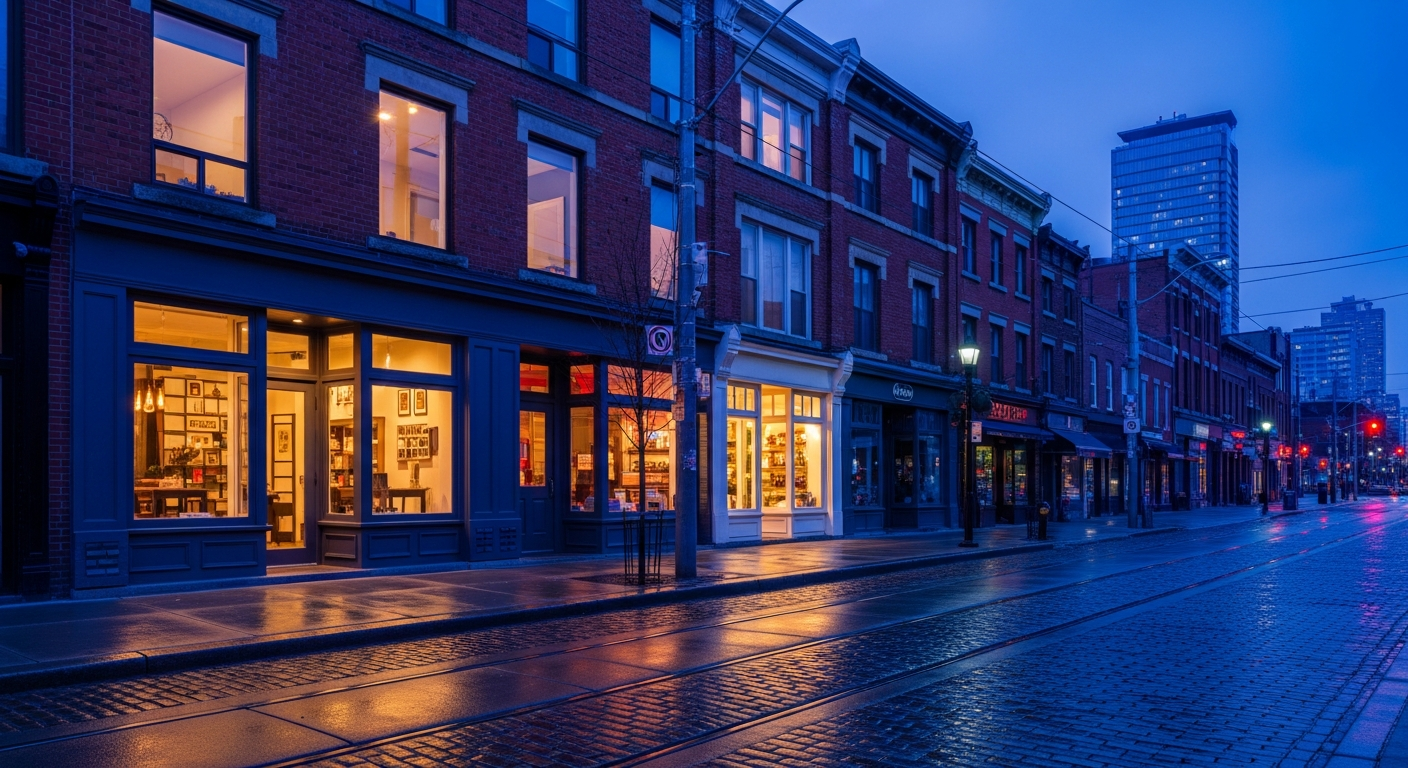
The single biggest mistake we see Old Toronto businesses make is treating SEO like they're a generic Toronto business. They're not. Downtown searchers tend to be on foot or transit, in a window of two or three blocks at most, and Google's local pack reflects that — proximity is weighted brutally hard. A Queen West cafe is competing against the seven other cafes within a three-minute walk, not against the entire west end. The right strategy is hyper-local, walk-radius-aware, and ruthlessly focused on the 5–10 highest-converting commercial-intent queries.
That changes the entire ranking calculus. The keywords you target shift from city-level ("coffee shop Toronto") to neighbourhood-and-vibe-specific ("third wave coffee Queen West", "specialty espresso King East"). Your Google Business Profile categories, services, and Q&A all need to reflect that walking-radius reality. Your citations need to live on hyper-local Toronto directories (blogTO, Toronto Life, Now Magazine listings, Toronto.com) in addition to the broader Yelp Toronto presence.
Old Toronto also has the most unforgiving review velocity in Canada. Competitive verticals downtown — boutique fitness, cosmetic dentistry, restaurants, salons, real estate brokerages, family law — often require sustained acquisition of 10+ new five-star reviews per month to break into and hold the top three Map Pack positions. The bar is brutal here, and that's exactly why generic agencies underperform.
None of this is theoretical. It's what we test, measure, and refine across our portfolio of downtown clients every month. Our Local SEO service overview walks through the broader framework. This page goes deeper on the specifics of Old Toronto.
Winning the Old Toronto Map Pack
The "Map Pack" — the three businesses Google shows above the regular blue links on local searches — captures roughly 44% of all clicks for commercial-intent local queries. For service businesses downtown, ranking in those three spots is worth more than ranking #1 in the regular organic results below — and the gap between #3 and #4 in the local pack is enormous in this market.
Every category, every service, every photo, every Q&A — Google rewards profiles that look like they're run by a real, attentive business.
Embedded maps, neighbourhood-specific service pages, NAP consistency across the entire site, schema markup that tells Google exactly who and where you are.
A steady stream of recent, detailed five-star reviews that mention service keywords and neighbourhood names — not a single batch from 18 months ago.
The unsexy truth is that 80% of Map Pack ranking downtown is operational discipline at competition-grade volume. Profiles in Old Toronto need weekly maintenance, not monthly. Photos need refresh cycles tied to seasons, menus, and inventory. Posts need to ship multiple times a week. Reviews need a structured acquisition workflow at the point-of-sale, not an afterthought. We treat downtown clients differently because the operational tempo has to be different.
On the technical side, schema markup deserves special attention. A correctly-implemented LocalBusiness, Restaurant, Service, or ProfessionalService schema with geo coordinates, areaServed arrays naming your actual Old Toronto neighbourhoods, and aggregateRating tied to your real review profile gives Google explicit, machine-readable signals that most downtown competitors are still missing.
Hyper-local strategy, neighbourhood by neighbourhood
Old Toronto is not one market — it's at least three dozen distinct micro-markets, each with its own demographics, competitive set, and search behaviour. A boutique selling in Yorkville (luxury, mature, expense-account) is selling something completely different from the same boutique on Ossington (creative, indie, millennial+). The merchandising is different. The price band is different. And the search queries are different.
| Neighbourhood | Search character | Best-fit verticals |
|---|---|---|
| Financial District / King & Bay | Corporate B2B + lunch/after-work | Law, accounting, B2B services, dining |
| Queen West / Ossington | Creative indie retail and dining | Boutiques, third wave coffee, design |
| King West / Entertainment District | Premium nightlife + condos | Restaurants, fitness, beauty, real estate |
| Distillery / Corktown / St. Lawrence | Heritage destination + new condos | Dining, retail, design, hospitality |
| Yorkville / Annex / Bloor-Yorkville | Luxury retail + university-adjacent | Luxury retail, dining, healthcare, design |
| Leslieville / Riverdale | Family-creative + indie commercial | Boutique retail, dining, healthcare, design |
| Roncesvalles / Parkdale / High Park | Family + Polish-Canadian + indie | Restaurants, healthcare, real estate, retail |
For each neighbourhood you actually serve, you should have a dedicated landing page with unique content, local imagery, an embedded map, neighbourhood-specific testimonials, and internal links from your homepage and service pages. Downtown, we typically build 8–15 hyper-local pages per client — one per high-converting catchment — because the marginal traffic from each neighbourhood adds up fast.
If you operate across multiple GTA municipalities, the same logic extends outward to North York, Scarborough, Etobicoke, Mississauga, Markham. The framework is identical — the local proof, citations, and content shift to match each market.
Industry-specific SEO playbooks for Old Toronto
Cross-industry SEO advice is largely useless downtown. An Old Toronto law firm, a King West restaurant, a Yorkville boutique, and a Distillery District salon are playing four completely different games — different keyword landscapes, different conversion funnels, different content needs, different review acquisition strategies. Below is the high-level framing we apply to the four verticals we work in most heavily downtown.
Hyper-local service-area pages for every neighbourhood you'll drive to, photo-rich project galleries, Google Business Profile services list matching your actual scope, and aggressive review acquisition tied to project completion.
Treatment-specific pages cross-mapped to neighbourhoods, schema markup for each treatment, careful review-acquisition workflow that respects regulatory guidelines.
Practice-area pillar content built to E-E-A-T standards, lawyer bio schema, jurisdictional content, and Toronto-specific authority building through legal directories.
Service-by-service x neighbourhood-by-neighbourhood matrix pages, fast mobile load times, click-to-call optimization, real-time scheduling integration.
You don't need to be in one of the four above to benefit — we maintain detailed playbooks for over 40 verticals across the GTA. Browse the full industries directory for the complete list, or skip to a free audit and we'll tell you what we'd do for your specific business.
Technical SEO checklist for Old Toronto websites

You can have the best content strategy in the GTA and still fail if the underlying website is broken. Downtown is even less forgiving — a one-second LCP delay in a market this competitive can drop you out of the top three. Below is the non-negotiable technical foundation we audit on every Old Toronto engagement.
- Mobile load under 2.5s on 4GLargest Contentful Paint must hit under 2.5 seconds on a mid-range Android over 4G — that's where your Old Toronto buyers actually are when they search.
- Properly structured schemaLocalBusiness, Service, Product, Article, Review, and FAQ schema implemented at the correct depth — not slapped onto the homepage and forgotten.
- Clean information architectureService pages, neighbourhood pages, and industry pages logically interlinked, with breadcrumbs Google can actually parse.
- HTTPS, hreflang (where applicable), canonical tagsThe boring infrastructure layer that prevents Google from getting confused about which version of your content to rank.
- Indexable, crawlable, and fastrobots.txt, sitemap.xml, meta robots tags, and internal linking depth all working in concert.
If your existing site can't hit those marks, the most cost-effective path forward is usually a fresh build on a modern stack rather than patching the old one. Our web design service bundles SEO-engineered architecture into every site we ship — Core Web Vitals in the green from day one, schema baked in at the component level.
How we measure success
Rankings are an input, not an outcome. The metrics that actually matter to a downtown business are qualified inbound calls, booked consultations, signed contracts, and walk-in foot traffic — and our reporting is built around them. Every monthly report we send a downtown client includes:
- Map Pack and organic ranking movement on every priority keyword, with neighbourhood-level breakdowns
- Total Google Business Profile interactions — calls, direction requests, website clicks, photo views
- Organic traffic and conversion funnels in GA4, properly attributed to source
- Form fills and call-tracking attribution from organic search, with audio recordings on request
- Review velocity and average rating across Google, Yelp, and other relevant directories
- Technical health score (Core Web Vitals, indexability, schema validity)
- Competitive benchmarking against your top three Old Toronto rivals
If your current SEO provider can't show you that level of detail in plain English, that's a problem worth solving. We're happy to audit their work for free as a second opinion.
Why Old Toronto businesses choose Toronto SEO
"King West is unforgiving — there are six restaurants within a block of us doing the same concept. Toronto SEO turned our Map Pack presence and review acquisition into our single biggest channel. We're now booked solid most weeknights."
We are a senior-led, Toronto-based SEO and web design practice with deep experience in the downtown market. Our typical client is a single-location professional firm, restaurant, retail concept, or service business doing C$750K to C$15M in annual revenue, frustrated with vague reporting and looking for a partner who treats their growth seriously in the most competitive zip codes in Canada.
Ready to talk? Request a free Old Toronto SEO audit, browse our transparent pricing, or read more about our approach and team.
Old Toronto SEO FAQ
The questions we get asked most often by Old Toronto business owners considering an SEO engagement.