
Toronto businesses are no longer losing market share because they can’t rank. They are losing it because traffic alone does not convert. In a city where nearly every competitive niche is saturated with SEO-savvy brands, ranking on page one is no longer the finish line—it is the starting point. AI-driven conversion optimization has become the decisive advantage separating high-traffic websites from high-revenue digital assets.
This article explores how Toronto SEO campaigns are evolving beyond keyword rankings, how artificial intelligence is reshaping conversion optimization, and how businesses can systematically turn organic visibility into measurable revenue growth.
Why Rankings Alone No Longer Win in Toronto’s SEO Landscape
Toronto search results are crowded, aggressive, and unforgiving. Law firms, clinics, SaaS companies, real estate brokers, and eCommerce brands all fight for the same attention. Ranking for competitive keywords might deliver impressions, but impressions without intent alignment, trust signals, and optimized user journeys rarely produce leads.
Modern SEO campaigns in Toronto must address three realities:
User intent has fragmented across devices, formats, and SERP features
Search behavior is increasingly predictive, not linear
Google prioritizes engagement signals tied to user satisfaction
This is why conversion-first strategies now dominate high-performing SEO programs, especially those outlined in advanced frameworks like Conversion-First SEO in Toronto, where traffic quality outweighs raw volume.
What AI-Driven Conversion Optimization Actually Means
AI-driven conversion optimization is not about automation for its own sake. It is about using machine learning models, behavioral data, and predictive analysis to continuously adapt content, layouts, and calls-to-action based on how users interact with a site.
Instead of guessing what converts, AI identifies patterns across:
Scroll depth and dwell time
Click paths across pages
Device-specific behavior
Geo-intent differences across Toronto neighborhoods
Micro-conversions before form fills or calls
This intelligence feeds real-time adjustments that human-only optimization cannot scale.
The Shift From Keyword Targeting to Intent Modeling
Traditional SEO focused on ranking pages for specific keywords. AI-driven SEO focuses on intent clusters—groups of searches connected by underlying goals rather than identical phrasing.
Toronto agencies leading this shift rely heavily on intent modeling frameworks similar to those discussed in AI-Powered SEO Clusters and Briefs, where pages are built to satisfy entire decision journeys, not just single queries.
AI analyzes:
Informational vs transactional intent
Early-stage vs bottom-funnel behavior
Comparison and validation searches
Local modifiers and urgency signals
The result is content that anticipates user needs before they explicitly express them.
How AI Optimizes On-Page UX for Conversions
High-ranking pages often fail because they overwhelm users with irrelevant information or poorly timed CTAs. AI-driven optimization continuously tests and adapts page elements such as:
Headline hierarchy and wording
CTA placement and phrasing
Page layout for mobile vs desktop
Form length and friction points
Trust indicators placement
By analyzing thousands of micro-interactions, AI determines which combinations drive higher engagement and lead completion rates.
This approach aligns closely with advanced CRO methodologies used in Full-Funnel SEO for Toronto Businesses, where each page serves a specific role in guiding users toward conversion.
Behavioral Data: The Fuel Behind AI SEO Performance
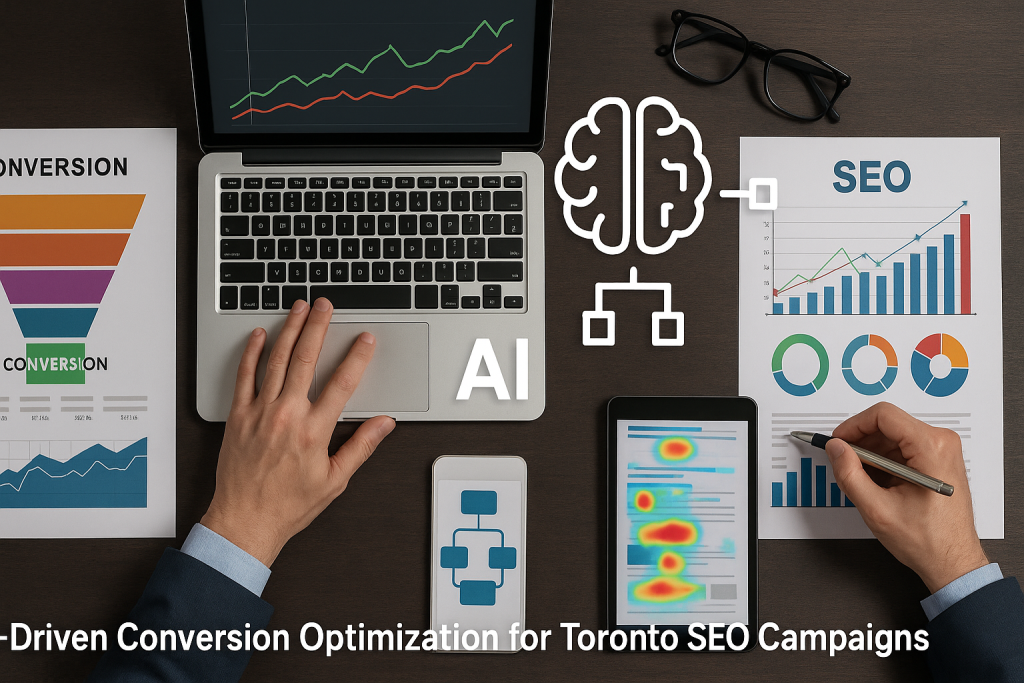
AI-driven SEO thrives on behavioral data. This includes first-party analytics, event tracking, heatmaps, and session recordings. Toronto brands investing in SEO performance measurement frameworks like How to Track SEO Performance With Analytics gain a decisive advantage by feeding clean data into optimization models.
Key behavioral signals AI uses include:
Bounce rate by intent segment
Conversion lag time across sessions
Assisted conversions from content pages
Scroll abandonment thresholds
Click hesitation zones
These insights allow SEO campaigns to evolve based on actual user behavior rather than assumptions.
Local SEO Meets AI Conversion Optimization
Local SEO in Toronto adds an additional layer of complexity. User behavior differs drastically between downtown searches, GTA suburbs, and mobile “near me” queries. AI identifies these differences and adjusts messaging dynamically.
When combined with local optimization strategies outlined in Why More Toronto Businesses Are Turning to Local SEO in 2025, AI enables:
Geo-personalized landing pages
Location-aware CTAs
Local proof signals based on proximity
Dynamic testimonials and reviews
This precision dramatically improves lead quality and booking rates.
AI-Powered Conversion Rate Optimization for Mobile Traffic
Mobile traffic dominates Toronto search results, yet mobile conversions often lag behind desktop. AI-driven CRO addresses this by analyzing mobile-specific friction points such as:
Thumb reach zones
Load-time sensitivity
Simplified navigation paths
Tap-friendly CTAs
Accelerated checkout or booking flows
These optimizations directly influence engagement metrics tied to rankings and conversions, reinforcing the connection between UX and SEO performance.
Trust, Authority, and AI-Enhanced E-E-A-T Signals
Trust remains a central driver of conversions. AI helps amplify E-E-A-T (Experience, Expertise, Authoritativeness, Trustworthiness) by identifying which trust signals matter most to specific audiences.
AI models test and refine:
Credential placement
Case study positioning
Review snippets and star ratings
Media mentions and certifications
Structured data for credibility
This approach supports trust-building strategies commonly discussed in E-E-A-T for Toronto SMBs while ensuring those signals actively contribute to conversions.
AI-Driven A/B Testing at Scale
Manual A/B testing is slow and limited. AI accelerates testing by running multivariate experiments simultaneously and learning from partial results.
This enables Toronto SEO campaigns to:
Optimize faster with less traffic
Identify winning patterns early
Reduce wasted experimentation time
Continuously refine conversion flows
AI does not replace strategic thinking—it amplifies it with speed and accuracy.
Compliance, Privacy, and Ethical Data Use
AI-driven optimization must respect data privacy regulations. Canadian businesses must align with federal standards such as the Personal Information Protection and Electronic Documents Act (PIPEDA), administered by the Government of Canada. Clear guidance is available through official resources like for lawful data handling.
Additionally, platforms such as Google Analytics provide documentation on ethical data usage and consent management via https://support.google.com/analytics. Responsible data collection ensures AI optimization strengthens trust rather than undermining it.
From Traffic to Revenue: Measuring What Actually Matters
AI-driven SEO success is measured by outcomes, not rankings. Leading Toronto campaigns track:
Lead-to-sale conversion rates
Cost per organic acquisition
Revenue per landing page
Assisted conversion influence
Lifetime value from organic traffic
This revenue-focused approach aligns SEO with executive-level business goals rather than vanity metrics.
Why Toronto Brands Are Reallocating SEO Budgets Toward AI
Toronto companies increasingly redirect budgets from pure link building and content volume toward AI-powered CRO because it produces compounding returns. A single optimized page can outperform dozens of unoptimized ones.
This strategic shift mirrors trends highlighted in Why Toronto Businesses Need AI SEO to Stay Competitive in 2025, where performance efficiency replaces brute-force tactics.
When to Integrate AI Conversion Optimization Into SEO Campaigns
AI-driven conversion optimization should not be delayed until after rankings are achieved. The highest-performing campaigns integrate conversion intelligence from the beginning, ensuring every ranking contributes to measurable growth.
Businesses that wait often discover their traffic plateauing without revenue gains—an avoidable outcome with the right framework.
Partnering With the Right Toronto SEO Experts
AI-powered conversion optimization requires strategic oversight, clean data, and technical execution. Businesses deciding between internal teams and external specialists often explore frameworks like Hiring a Toronto SEO Expert vs Doing It In-House to determine the most effective path forward.
Expert-led campaigns ensure AI tools are applied with intent, not blindly deployed.
Next Steps: Turning SEO Traffic Into Predictable Growth
AI-driven conversion optimization is no longer optional for Toronto SEO campaigns. Rankings without conversions represent lost opportunity. Businesses ready to transform organic traffic into predictable revenue should begin with a comprehensive strategy review and performance audit.
For tailored guidance, strategic planning, and AI-powered SEO execution, connect directly through Toronto SEO Contact Page to explore conversion-first solutions built for competitive Toronto markets.
FAQs
What is AI-driven conversion optimization in SEO?
AI-driven conversion optimization uses machine learning and behavioral data to improve how SEO traffic converts into leads or sales by adapting content, UX, and CTAs dynamically.
Does conversion optimization impact SEO rankings?
Improved engagement, dwell time, and user satisfaction signals indirectly strengthen SEO performance while increasing revenue from existing traffic.
Is AI conversion optimization suitable for local Toronto businesses?
Yes. AI excels at local intent modeling, geo-personalization, and mobile optimization, making it especially effective for Toronto-based campaigns.
How long does it take to see results from AI-driven CRO?
Initial improvements often appear within weeks, with compounding gains as models learn from ongoing user behavior.
Is AI-driven SEO compliant with Canadian privacy laws?
Yes, when implemented responsibly and aligned with PIPEDA and consent-based data collection standards.
