
Toronto search results in 2025 no longer behave like traditional blue-link listings. The modern SERP is a layered, intent-driven ecosystem where visibility does not automatically equal traffic—and traffic does not automatically equal revenue. Businesses that still optimize only for “rank #1” are already behind. The real advantage now lies in understanding which SERP features dominate attention, siphon clicks, or redirect intent—and how to position a brand to win inside them.
This breakdown delivers a precise, business-grade analysis of where clicks actually go in Toronto SERPs in 2025, how Google reshapes intent before users ever reach a website, and how companies that understand this reality are outperforming competitors that still chase outdated metrics.
How Toronto SERPs Fundamentally Changed in 2025
Toronto is one of the most competitive search markets in North America. High advertiser density, aggressive local SEO, and early AI rollout mean Google tests features here before many other regions. As a result, Toronto SERPs now function as decision engines, not discovery tools.
Search results are no longer linear. They are stacked, personalized, and context-sensitive, with Google answering, filtering, and narrowing choices before a click ever happens. In many industries, fewer than half of searches result in a traditional organic click.
This shift has created a new hierarchy of visibility—one where SERP real estate matters more than raw ranking.
Featured Snippets: The First Click Killer (and Winner)
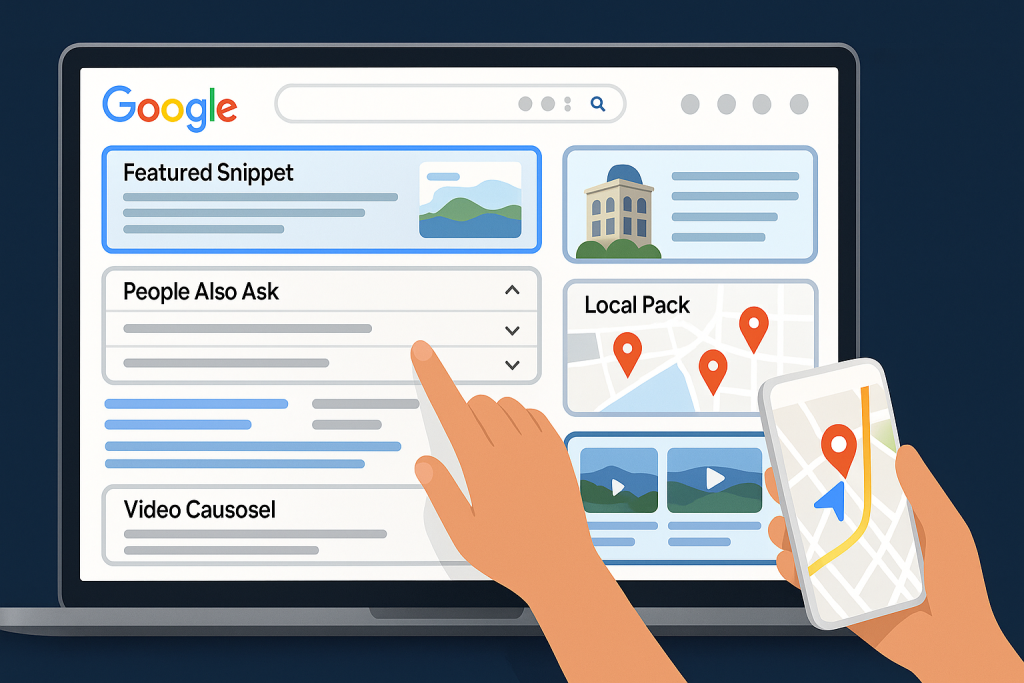
Featured snippets dominate informational and commercial-informational queries across Toronto. These appear above organic results and often satisfy user intent instantly.
What’s happening in Toronto
Snippets are longer, more structured, and increasingly multi-source
Google favors entity-backed, concise, authoritative explanations
Snippets now appear for local service modifiers (e.g., “Toronto pricing,” “near me costs”)
Where clicks go
If your brand owns the snippet: brand recall + downstream conversions
If not: clicks drop sharply—even if you rank #1 organically
Winning snippets now requires intent compression: answering the question better than Google expects, not longer than competitors. This aligns directly with modern content optimization strategies discussed in Content Optimization: Boosting Engagement and Rankings.
People Also Ask (PAA): The Hidden Click Funnel
People Also Ask boxes have quietly become one of the most influential SERP features in Toronto. They expand mid-scroll and intercept users who are still evaluating options.
Why PAA matters more in 2025
PAA questions are intent-stacked, not random
Clicking one question often reveals another—keeping users inside Google longer
Answers heavily influence brand trust before a site visit
Click behavior
Users often read multiple PAA answers before choosing one site
Brands appearing multiple times gain disproportionate authority
Optimizing for PAA is no longer optional. It requires structured answers, schema alignment, and entity clarity—concepts deeply connected to how top Toronto firms approach strategy, as outlined in What Makes a Great Toronto SEO Company.
Local Pack (Map Pack): Where High-Intent Clicks Still Convert
For service businesses, the Local 3-Pack remains one of the most click-dense SERP features in Toronto—but competition has intensified dramatically.
Key changes
Fewer clicks to websites, more clicks to calls and directions
Reviews, categories, and proximity signals outweigh traditional SEO factors
Google Business Profile interactions now matter more than page visits
Where clicks go
Phone calls
Driving directions
Profile actions (messages, bookings)
This reinforces why Toronto companies are doubling down on local-first strategies, a trend explored further in Why More Toronto Businesses Are Turning to Local SEO in 2025.
AI Overviews and SGE Panels: The Zero-Click Accelerator
AI-generated overviews have become one of the most disruptive SERP features in Toronto. These panels synthesize answers across multiple sources and appear above or alongside traditional results.
Impact on clicks
Informational queries often result in no click at all
Commercial research queries push clicks deeper into the funnel
Brands cited inside AI summaries gain indirect authority, even without traffic
Google itself acknowledges the direction of AI-powered search in its public documentation on search quality and AI systems via resources like Google Search Central.
The implication is clear: being cited matters as much as being clicked.
Video Carousels: Attention Without Immediate Traffic
Video results—especially YouTube—dominate Toronto SERPs for how-to, comparison, and explainer queries.
User behavior
Users watch before they read
Video builds trust faster than text
Clicks often go to the brand later, not immediately
For many Toronto brands, video SERP visibility acts as pre-conversion conditioning, supporting full-funnel SEO approaches rather than direct traffic capture.
Image Packs: Visual Validation Before Action
Image results now appear frequently for local services, products, and even professional industries in Toronto.
Why image packs matter
Users scan visuals to confirm legitimacy
Branded images reinforce trust signals
Clicks often flow to Google profiles, not websites
This visual-first validation layer has reshaped how users choose who to contact—especially in crowded service markets.
Paid Results vs Organic Features: A Blurred Line
In 2025, the line between ads and organic visibility is thinner than ever in Toronto SERPs.
What changed
Ads mimic organic layouts
Paid placements appear inside local packs and carousels
Users scroll past ads faster but still absorb brand exposure
This is why leading Toronto brands increasingly blend strategies rather than choosing one, a dynamic examined in Why Toronto Brands Are Combining Google Ads and SEO for Maximum Visibility.
Where Clicks Actually Go: The 2025 Reality
Across Toronto SERPs, click distribution now follows a clear pattern:
High-intent local searches → Local Pack actions
Informational searches → Zero-click or PAA
Commercial research → AI summaries + comparison content
Brand searches → Knowledge panels and sitelinks
Organic blue links still matter—but they are no longer the primary driver of visibility.
Winning SERP Visibility Without Chasing Traffic
The most successful Toronto businesses in 2025 do not measure success by sessions alone. They optimize for:
Brand mentions inside SERP features
Multi-touch visibility across PAA, snippets, and local results
Conversion actions initiated directly from Google
This strategic mindset aligns closely with advanced funnel thinking discussed in Full-Funnel SEO: Turning Toronto Website Visitors Into Paying Clients.
Why Traditional SEO Metrics Fail in Toronto Now
Rankings, impressions, and raw traffic fail to capture:
Assisted conversions
Brand lift from zero-click exposure
Local actions that bypass websites entirely
Modern Toronto SEO success is measured by influence, not just visits.
The Competitive Advantage Going Forward
Toronto SERPs will continue to evolve toward:
More AI mediation
Fewer neutral clicks
Greater emphasis on entity trust
Businesses that adapt to SERP feature dominance—not fight it—will capture demand while competitors argue about rankings.
For organizations ready to align strategy with reality, the next step is clear: visibility must be engineered at the SERP level, not just the page level.
Next Steps: Strategic Action
Toronto companies serious about dominating modern search visibility should reassess how they appear across SERP features—not just where they rank. Strategic guidance, competitive analysis, and feature-first optimization can be explored directly via the Toronto SEO contact page.
Frequently Asked Questions
What is the most important SERP feature in Toronto in 2025?
The Local Pack remains the most conversion-driven for service businesses, while AI Overviews dominate informational intent.
Do featured snippets reduce website traffic?
Yes, but they increase brand authority and downstream conversions when owned strategically.
Are organic rankings still relevant in Toronto?
Yes, but only as one component of a broader SERP visibility strategy.
How does AI search affect Toronto businesses?
AI reduces direct clicks but amplifies brands cited as authoritative sources.
Can small businesses compete in Toronto SERPs?
Yes, by targeting local intent, SERP features, and niche authority rather than broad keywords.
